 I arrived in Santa Barbara at the beginning of the redwood hot tub fad of the 1970s. I plunged into the fad and one of my first clients was a hot tub company.
I had two brothers in town. My brother Scott was art director at California Press, publishers of brand new Santa Barbara Magazine. I talked my way into working there as a writer, editor, and paste-up and graphic production guy.
My brother Matt worked at Car Parts on Milpas Street in the back room grinding brake drums. His wife Nancy was the bookkeeper at Car Parts. She was a native Santa Barbarian; she and Matt regularly attended hot tub parties with friends from her high school days in the circle around Noel Young, owner of Capra Press, who had recently published “HOT TUBS: How To Build, Maintain, and Enjoy Your Own Hot Tub,” the book that kicked off the hot tub boom. He wrote it under the pseudonym “Leon Elder,” perhaps because of all the nudity in the photos.
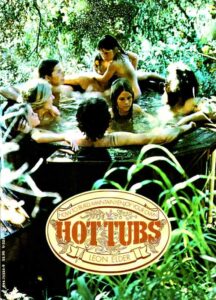
I saw nothing wrong with nudity. I was born nude. My ex-wife Rhonda and I had lived in a nudist commune on an island for a summer before we dashed from Detroit to California when we were 22. I was already a proto-nudist when I encountered hot tubs.
And hot tubs turned out to be a friendly space. The dedication of the Hot Tub book was to “warmth, trust, and camaraderie in an overcrowded and suspicious world.”
There’s a salaciousness about hot tubs because of the nudity, but sex wasn’t the core of it. It wasn’t just the bare boobs to stare at that attracted me. Sipping cognac and discussing great books while blissfully relaxed from pervasive heat was a lot of fun. The superficialities of modern culture were swept away. We bared our true thoughts.
Nationally, California was considered a hotbed of sin anyway. Hot tubs were seen as just another of the dope-crazed West Coaster’s search for new rutting rituals.
Everybody was nude, yeah, but as one person says in the HOT TUB book, it’s like “orgies without the sex.” Lots of booze and talk and I always brought my nylon-string guitar and joined in playing music, yes, but I never saw anybody having sex. Nor even slipping into the house together for a bang.
Another quote from the book: “One half-hour in 110-degree water results without exception in what might be described as ‘boiled noodle effect.'”
At first the water is too hot, but your body adjusts to it and that’s when you get the deep relaxing heat penetrating to the bone. And a blissful calm seeps into you. A soul-deep relaxation takes over.
Hot tub parties became a regular part of my life, a once-or-twice-a-month activity. Usually they were also barbecues. I became a regular and contributed tri-tips and cognac. I brought my acoustic guitar and strummed chords along with other musicians.
There was zero crossover between the hot tub people and the people at Santa Barbara Magazine. The hot-tubbers were mostly academics; the SBMag folks were independent contractors, not employees.
After the issue with my first magazine article was published, prospects at the magazine faded away. California Press was broke. The publisher ended the contract with my brother’s design company and hired some other designer for the next issue.
My brother found a job as art director for a giant ad agency in Detroit on the Pontiac account. In January 1977 he wound down his affairs in Santa Barbara, sold his business equipment to his employee, Mark Oliver, and left town forever.
I rented a corner of what had been Scott’s art studio in the same building with California Press and became Colin Campbell, Copywriter. I shared the office with art directors Mark Oliver and John Alexander. I began looking for clients for my copywriting skills.
Mark Oliver and I had long convoluted discussions about how to find clients and present our hot young creativity to the world. Mark was fanatically determined to win awards in the graphic design universe. He could make things look pretty on the page. What I did was to determine which things should be on the page.
While my brother’s business was in operation I’d been writing ads for crappy little local clients. The La Arcada shopping center on State Street. The UCSB Alumni Association. The Hollister Ranch people wanted a campaign against the liquid natural gas facility being constructed at Point Conception, but after I wrote a bumper sticker for them, “Keep Point Conception Immaculate,” they laughed at me and refused to pay. Then one of their own talented writers independently came up with a totally completely different slogan that they printed up, “Keep Conception Immaculate.”
An art director I knew called me from San Luis Obispo–his client needed a re-write of their annual mail order stereo catalog featuring a dozen turntable-receiver-speaker sets from entry-level to top of the line.
I drove 90 miles north to San Luis Obispo and met Cliff Branch, the owner of Warehouse Sound, the largest mail-order stereo company in the United States.
He was dubious of my skills because I had no music-industry examples in my portfolio. He warily agreed that I would write the text for one of the stereo systems and if that turned out satisfactorily, they’d hire me for the whole catalog.
I brought home copies of all of the company’s previous mail order catalogs and studied them. The earliest ones were written by Cliff Branch himself and reeked of authenticity: when he was a college student he was maniacally interested in stereophonic sound equipment. He started by seeking out the best price for a speaker. Other guys in the dorm asked him to find similar deals for them for speakers and turntables and stereo receivers. It became a business for him.
The catalogs he wrote were totally honest and believable. But then the company grew exponentially and the catalogs grew in size over the years and began including color photography instead of just text, and their ad campaigns in NATIONAL LAMPOON and PLAYBOY and COSMOPOLITAN began to display the workers at the warehouse who were diligently getting your new stereo system shipped to you. And the catalogs began to show the warehouse people partying on the beach with their $5,000 stereo system exposed to windblown sand and salt spray, a mile from any electrical outlet.
The latest catalog that I was supposed to emulate was bullet points crunched into paragraphs with none of the confident vibe of the earliest days. All they wanted was a replication of the same old stuff with different brand names featured. I tried several times and wasn’t able to generate anything worthwhile. I was deep in depression and postponed delivery of the sample chapter.
Then I suffered a concussion in a softball game. I clopped a slow grounder to shortstop and ran to first base and the shortstop’s throw hit me in the head. I stayed in the game and subsequently hit two triples and we won.
Somehow I turned into a real writer after I got hit in the head. It cleared my thinking. Brought me to my senses. I realized I’d been dazed for months…years. I began revealing and expressing my opinions more assertively.
At the office, Mark Oliver complained that I was aggressive and loud since the beaning. “I don’t have to put up with these emotional outbursts,” he said.
I was surprised because I didn’t realize I was being emotional. What I realized was that the local adbiz competition wasn’t creating anything except easy standard stuff aimed at pleasing the client rather than tempting the reader of the ad.
On the day I was supposed to present my sample chapter about stereos to the client in San Luis Obispo, I did not have it completed. Instead I told the owner what I’d deduced from reading all the previous catalogs. I drew a graph on the blackboard showing my estimates of the comparative results of the different catalogs–a downward trend. The owner now used a $10,000 turntable; he had no empathy for the first-time buyer. He still was writing the text for the highest-end system. “You have to reverse things,” I told him. “Your existing text for the lowest-end is deprecatory to, and dismissive of, the low-end buyers. You have to change the tone–show them that this is the very best possible stereo system you can buy for only this much money. And the next-highest system is an even better value!”
I told them they should throw out their existing marketing campaign based around the warehouse workers and go back to intense focus on the actual stereo equipment. That’s what potential customers want to look at.
They hired me to do it. The resulting catalog and magazine ads won the Gold Mailbox for Best Multi-Media Campaign from the Direct Marketing Association that year.
Mark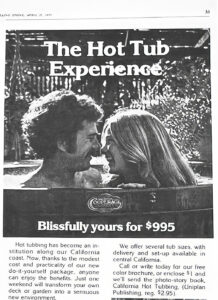 Oliver got an inquiry from Gary Gordon and Richard Grant, manufacturers of redwood tanks for the Santa Barbara wine industry. They wanted a magazine ad to take advantage of the hot tub boom, especially after a San Luis Obispo company began marketing hot tubs with a national magazine campaign.
They didn’t have the budget to run full-page ads in Playboy and Rolling Stone and National Lampoon like the competitor company. They wanted an ad for Swimming Pool Weekly, a trade magazine.
Mark and I planned out how to do it. I found copies of all the trade magazines from the swimming-pool corner of the universe and thumbed through a few years’ worth of them and saw that ads for redwood tubs were trying to latch onto the new trend with photos of hot babes in tubs. The target audience for their ads seemed to be college students. Oooh, yeah, soaking with Hollywood starlets, that’s the dream, the groovyness of climbing into a hot tub with a bunch of naked girls.
But after a year of soaking in tubs I could see that only homeowners would have a place to put a tub. Demographics showed that the main buyers of hot tubs are forty to sixty years old. The competitors’ ads suggested you could buy the kit and assemble a hot tub over a weekend. I’d helped with repairs for pumps and heaters and plumbing for friends’ tubs, and I knew it was a lot more complicated than that.
I aimed the ad directly at pool dealers and home improvement companies, showing them how they could cash in on the trend. I explained how the plumbing and heating fittings were industry standard equipment they were already familiar with.
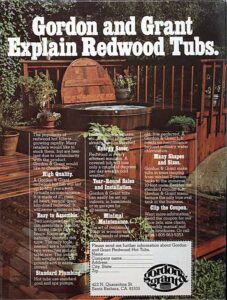 I asked Gary Gordon and Richard Grant if they were truly prepared for the kind of response the ad would bring. Bring it on, they said. Maybe they thought I was giving them adbiz hype. They were swamped by the orders generated by the ad.
Hundreds and hundreds of companies responded to the ad and I put a big US map on the wall and put pins in the cities where the responses were. I was surprised that New Jersey had the most responses. Somebody explained to me that New Jersey was where all the workers of New York City lived.
It was the first time I was able to put my personal experience into an ad campaign.
The ad offered a four-color brochure, so when the coupons started flowing in we had to create a brochure! I aimed the brochure at homeowners and emphasized the consumer benefits. Mark Oliver and photographer Henry Fechtman and I designed it into such an interesting piece that it was featured in an issue of COMMUNICATION ARTS magazine, the bible of the graphic design industry.
Also that summer I created a series of award-winning ads for a company in the silicone boob industry, and the company grew so large it had to leave Santa Barbara in order to expand. And I wrote a brochure for a local manufacturer of a sportscar, the Boa Aerocon. That attracted the attention of BBDO, the world’s fourth-largest ad agency, who decided to hire me to write Dodge Truck commercials.
And besides all that, my softball team won the Santa Barbara City League Championship. It was a very good year. I went to Joe’s Cafe almost every night and drank my brains out.