I wuz gunna write a memoir called “Sex as an Art Form” based on my relationship with a sex-obsessed heiress that began when I arrived in Santa Barbara in 1979. I wrote 427,000 words of journal entries during that first year with her but never looked back at them for fear of rekindling ancient pains. Maybe now enough time has passed that I can read my old jottings dispassionately.
I sifted through the journals of that first year and found 67,000 words about us. I intended to write an analysis of what kind of person she was and to try to figure out what had gone on between us.
But what caught my attention was the 360,000 words about my dealings with my colleagues in the Santa Barbara adbiz.
They were scheming against me left and right, and I didn’t notice. It was several years before I learned what they were doing, and it was startling to read about it in that first year’s worth of journals.
I was pretty cocky. I’d left Santa Barbara Magazine to take a writing job at a big-time ad agency, and now I was back after spending two years writing print ads and TV commercials for the Dodge & Dodge Trucks account. I was glad to get away from there, even though it was the best-paying job of my life. I made the same money as the Detroit Tigers’ rookie shortstop.
When I arrived in Santa Barbara in 1979 I rented a one-bedroom apartment and I rented office space in the same building as Santa Barbara Magazine and resumed writing articles for them.
I contacted all the ad agencies and graphic design shops in town to tell them I was back.
Mark, an art director who was one of my best pals, had an immediate project for me: the Zoo had a problem, they needed public support for something. Could I do a freebie for them? They already had the headline for the newspaper ad: SOS. That told you all you needed to know, and I could fill in the body copy.
Instead I went to the Zoo and asked people what was going on and I talked to the sea lion, too, although he didn’t reply. Turned out that SOS meant “Save Our Sea lion.” I arrogantly tossed that aside and wrote this ad telling people what to do to help:
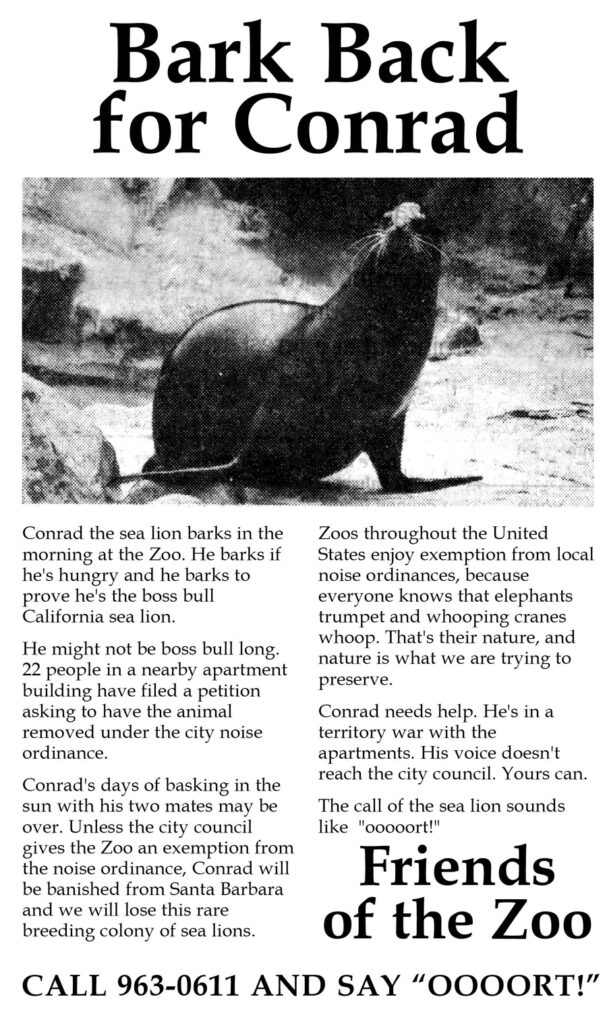
In the ad I didn’t mention that it was the Mayor’s phone number and the City Hall switchboard was swamped for days by people calling and barking like a sea lion.
It was such a fun story that the major Los Angeles TV news departments sent crews to Santa Barbara. The mayor came out on the City Hall steps to announce the City Council’s decision to the crowd of reporters. He grinned and said, “Ooort!”
Santa Barbara in the pre-digital age was a hotspot of creativity on the national map in the advertising and graphic design biz with a full complement of graphic-production-based trades–typesetters, paste-up artists, photographers and photo processing labs. Print shops, photostat shops. We were a mere bump compared to New York and Los Angeles, of course, but Santa Barbarans won national design awards at a similar per-capita rate as the big cities.
The graphic designers I knew desperately wanted to win awards and be displayed in industry trade journals such as Art Direction, Ad Age Creativity, Print, Graphis, and, primarily, Communication Arts magazine.
I didn’t care about that. It was pleasant when the stuff I wrote for them was winning awards, but I didn’t have the same core center of worry plaguing the art directors. Being mentioned in those ‘zines was their lifeblood.
All I wanted to do was to write ads and brochures that worked.
So I wrote and wrote. I wrote an interview with Rin Tin Tin and the Santa Barbara News & Review ran it as their cover story o December 6, 1979. It’s still the funniest thing I ever wrote, although dated by now of course.

An art director asked me to help with a catalog for a guy who made electric pickups for guitars. The campaign turned out to be the sensation of the NAMM show (National Association of Music Manufacturers); sales were ten times higher and Seymour Duncan was catapulted into industry leadership.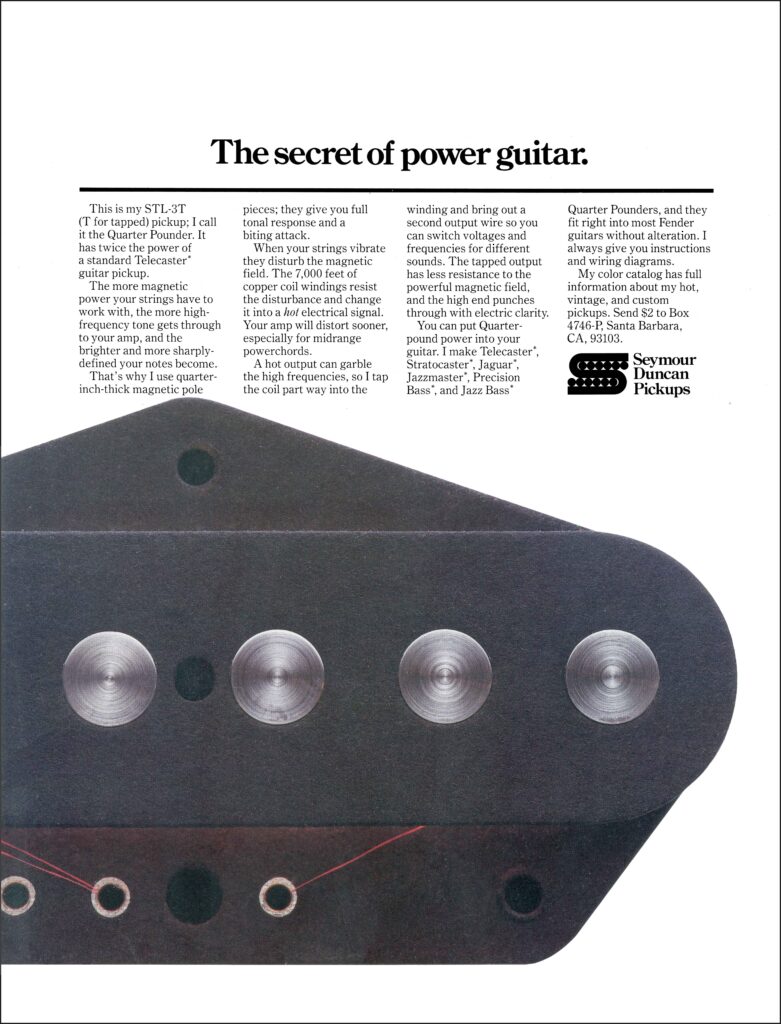
Another art director asked me for help with his self-promo. He wanted a hard-boiled detective novel written in the style of Raymond Chandler (THE BIG SLEEP), except only 9 pages long and the art director was to be the hero of the novel. The story turned out to be such fun that it won many awards in the graphic design industry in Europe and America. It became the subject of an astonished article in COMMUNICATION ARTS magazine. It worked to the extent that the art director was bombarded by job offers from Silicon Valley and left town and he never talked to me again.

Santa Barbara Magazine published my article about research projects at UCSB. But then I saw that the art director had guaranteed that nobody would ever read my article because he presented it reversed: the first 250 words of the article are white against a mottled dark blue background. A slight jog in the printing registration blurs the text. The typography is tightly jammed in a too-small font. Was it incompetence, or negligence, or evil intent?

The things I wrote for the designers won awards. I was startled to discover in my journals that although the things I wrote won awards and increased sales for the clients, I was broke. Half of my journal entries were about my desperate search for the rent money. What I see now in the journals is how naïve I was regarding my so-called pals. Right from the start. It took me several years to figure out what they were doing to me. Poisoning me behind my back. Poseurs with Machiavellian intrigue and subterfuge behind every move.
The other guys were trying to find clients they could milk for years. I was interested in doing the projects. Once they had the client roped in after the success of my ads, they didn’t need me any more.
The astonishing thing I’ve found in reading the old journals is the constant theme of the art directors and agency heads continually preferring to cave in to client pressure in order to deliver sub-standard stuff. Now that we’ve landed this client, we can’t take chances, we have to present non-controversial stuff. Also we have to start paying Colin a lot less.
They didn’t like doing what the client wanted. The clients were all jerks who rejected their creative ideas. My ideas were weird and the clients would never accept them, except when I presented them, the clients liked them. This was because I was listening to the clients and studying their market.
I preferred simple stuff. And that’s why, after a year, I was a flop.
Well, I wasn’t exactly a flop. I wrote a lot of stuff. I made enough money to barely scrape by on.
I was self-employed, but I was not a good businessman, I was merely a skilled writer. It was hard work. The ad agencies and graphic design shops were making the easy money, the commissions for printing and placement, the markup on supplies, the kickbacks and altered invoices, and the leverage of handling the media money.
They didn’t need my help for that stuff. I was puzzled by my poverty because even though I was doing good work, I wasn’t getting any return business. The old journals tell me that Mark wanted me to think it was because the clients hated me, my personality was so awful.
It took me several years to learn this. The evidence is right there in the journals but I didn’t see it at the time, not until the finale of the Stubbies account.
Stubbies was an Australian swimwear manufacturer trying to crack the American market. AdWeek magazine ran their announcement of open competition for their account; Mark and I created one of my typically idiosyncratic proposals and we mailed it in, but we didn’t make the cut for the final interviews.
Shrug, move on to the next project.
A year later, the account was on the loose again, and the Stubbies people remembered the proposal I wrote and said they were interested in coming to Santa Barbara to talk to us.
Mark was in a frenzy because it could mean BIG MONEY, but he’d thrown away my proposal. He called me to ask if I still had a copy: yes. He asked me to attend the meeting when the Stubbies people came to town. Sure.
On the day of the meeting I climbed the stairs to Mark’s second-floor office on State Street, and saw four new employees busily doing nothing. Mark stocked his office with temps for one day to make it look like he was a much larger operation than just a guy with one graphics girl/receptionist on the payroll.
And then I was charming and effusive and persuasive in the meeting, and Mark won the account.
Stubbies shipped a trunkload of shorts and swimsuits and activewear to Mark’s office and that’s when he told me he’d decided I wasn’t the right copywriter for this project, he was hiring somebody else. Buh-bye. I wasn’t fired, I was a freelancer, and from now on he didn’t need me.
But it wasn’t until five years later that I learned what was really going on. I attended the annual Ugly Lamp Show (my entry won second place) and bumped into a woman who said she remembered me, I wrote a brochure for her. Took me a minute to recall: yes, she ran a bar exam workshop for Harcourt Brace. She wanted to thank me because the brochure was very successful, but mostly she wanted to tell me how frightened she was on the day I’d interviewed her for the project. Mark had filled her ears with cautions. “You’re not going to like Colin,” he told her, and listed all the things wrong with me.
She was terrified of the ordeal Mark warned her about, she said, and then her fear faded when I turned out to be seriously interested in her project and she spoke enthusiastically about what she wanted and the brochure I wrote captured all the essence of her offer to law-school grads. And this, she said, made her question what kind of agency Mark was running. If he was so deceitful about this, what else was he lying about? And so she never used him again.
That’s how I discovered it wasn’t paranoid schizophrenia, they really were out to get me.