“The cat suit has to fit tightly to your body, so you’ll have to strip down,” Lars had told her. “Put it on as though it’s a wetsuit, you’ve been diving, you know the drill. Or spandex.”
She started with the cat suit rolled up inside out from the waist down. She put in her feet and pulled it up over her calves and knees and thighs, making sure every part was snug.
The fabric wasn’t like a wetsuit, it was fine-grained with a unique texture. Lars had told her how it works. “The suit is made from a graphene fabric embedded with thousands of piezo quantum dots that expand and contract a little according to what the cat is feeling, and you can feel it, too. It’s just a slight pressure on your skin that changes according to what the cat is doing. After you get accustomed to it and you’re immersed in the experience, your brain interprets the pressures in rapport with what you’re seeing and hearing from the cat’s point of view. It’ll quickly become normal and you’ll be in a cat’s body.”
The top had a zip-up front. The lump at the nape of the neck of the cowl was a transmitter module. She put on the gloves and sat down in her Barcalounger. Where was the cat?
The actual cat, a Siamese named Patzy, was sitting in the sun in the front windowsill looking out at the lawn.
Patzy had demonstrated verve and agility and a musical voice in the two days since Lars delivered her.
“Let the cat get used to your house for a few days before you put on the cat suit,” he told her.
Emily was grumbling inwardly. Why do I let people talk me into these things. “I don’t know anything about cats,” she’d told Lars.
“That’s okay, all we want is your evaluation of your experience and for you to appear with your opinion in our introduction event next month.”
Emily finished all the items in the checklist of the Cat Suit app on her phone, inserted the earbuds, and put on the virtual-reality headset, a modified Apple Vision Pro.
And then she was looking at her lawn through the eyes of the cat as presented on the stereoscopic video screens in the headset. She turned her head and the view shifted, she turned further and felt it in her arms and upper body. Then she was looking at herself lying back in the Barcalounger.
She dropped down to the floor and as the cat walked toward the chair she felt the impact on her hands and feet, but the weight was on her knuckles. The cat knew how to walk and Emily didn’t have to consciously operate each leg. The computer chip implant in the cat made it do what the human wanted instead of what the cat wanted. The cat didn’t notice the difference.
Emily moved her body as though to stop, and the cat stopped. Emily lifted the right paw and looked at it and flexed open her fingers and the claws extended out.
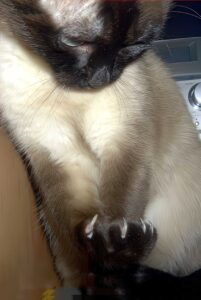
She resumed walking and it took only moments for Emily’s brain to absorb the sensations into a fully natural gait as she steered the cat across the carpet. Lars had said her brain would adapt and develop a synthetic sense of proprioception, the “sixth sense” that lets your brain understand the body’s position, movement, and force.
“Patzy’s body positions are transmitted from microGPS transmitters in the cat’s bloodstream and sent to the pulsing piezo dots in the catsuit,” Lars had told her.
She didn’t have to control every motion. The cat continued its normal life and Emily was just along for the ride, feeling her way and adjusting to her point of view from eight inches above the floor. Able to see that the undersides of low shelves needed to be dusted, another job for her to-do list.
She discovered that sitting in the Barcalounger was not giving her corroborative meshing with the sensory surfaces of the suit. Her actual body was reclining, not down on all fours.
She took off the headset and went into the studio to the far end to her gymnast’s vault horse. She hadn’t been exercising on it enough lately. She laid down on it prone, face down with her arms and legs dangling down on the sides, and put the headset back on.
Now her real senses and the catsuit vibrations were more in synch. The cat followed her into the studio on its own–she hadn’t been allowed into the studio until now. Patzy was prowling among the detritus of the studio–stacks of her sculptures on racks: swooping abstract curves of marble in her non-verbal “calligraphic” mode in various stages of completion.
And her current bete noir, another goddam octopus sculpture, fresh back from the marble 3D printing shop with innumerable errors in the chromatophores–the pigment-filled cells that can change from one iridescent color to another for camouflage.
The octopus was on the main work table and it was easy to move the cat toward the table. She crouched down and looked up and leaped and the cat’s normal leaping instincts took over and she landed on her feet. The cat wanted to cautiously sniff the octopus sculpture and Emily let that happen.
Emily had been avoiding the octopus. She faced the tedious task of altering the surface of myriads of chromatophores to conform with the version the client had approved, after long and tedious changes by the client. The AI-controlled 3D marble printer had done a very good job, overall, but as always it was the final details and polishing that took up most of the time. Every detail had to be perfect.
The octopus was an anomaly. Emily resented the popularity of the octopi sculptures. The first one was a commission. A client had pressured her into making the first one and then it was unexpectedly successful and now all she was doing was carving octopi and she was tired of it. Her true creativity, she thought, was in her abstract entanglements of spirals. Three-dimensional calligraphy without the words.
She’d met Lars at her opening at the art gallery last month where she’d had zero octopi on display. Her friend Svetlana attended the opening–she’d been on the UCSB gymnastics team with Emily back in her college days.
Hardly anybody was looking at Emily’s sculptures. Svetlana said, “Maybe it’s because your sculptures are static, instead of flowing and pulsing like regular 3D holograms. Actual marble is so archaic.”
“I think it’s because Suzy Glitter’s nudes are wowing the crowd,” Emily said, gesturing to the other side of the gallery.
Svetlana’s date was Lars, who startled Emily by saying, “The thing I see in all your pieces is that it looks like they’re all flowing in sets and subsets of the Golden Ratio.”
“Well, yes,” she said, astonished. “I’ve been exploring abstract equiangular spirals, and the Golden Ratio is one of them.”
Lars said, “It’s the Fibonacci sequence behind it all. Nature uses the Fibonacci sequence everywhere. The number of petals on a daisy, the arrangement of seeds in a sunflower head, the spiral of a nautilus shell, the curving arms of a galaxy, the sequence of keys in Claude Debussy’s “Reflets dans l’eau,” a lot of beauty grows out of the Fibonacci sequence. What’s your process for developing these sculptures?”
“Well, I work in 3D modeling, of course, and I design my calligraphic curves and then I’m always in my virtual reality headset. I make a life-size VR version in wireframe and cloak it in marble. I have microGPS gloves that simulate the sense of touch for feedback. Then I use VR tools to manually chip and polish the marble into final shape, exactly the same way classic sculptors carved marble.
“If I go beyond what actual marble can tolerate, if something breaks off, I have the miracle of the undo function.”
The doorbell rang and startled both Emily and the cat. She leaped down and went to the window by the door. She saw Svetlana and her friend Adrienne–they were baristas together at a luxury restaurant in Montecito.
Lars’ crew had installed a cat door in Emily’s house. She dashed outside to greet her friends.
“Oh, this must be the cat Emily was telling us about, Lars Whitney gave it to her.”
“Why is she being so mysterious about it?”
“She said she had to sign a non-disclosure agreement about it, it’s something about a project for Lars’ company.”
Svetlana rubbed the cat’s head and then down the spine to the rump and the cat flexed upward.
Adrienne rang the bell again and knocked on the door again.
Svetlana said, “She’s still not answering her phone. She must be locked in her studio again.”
“She thinks she’s so perfect,” Adrienne said. “Nobody is good enough for her.”
“I don’t know about that,” said Svetlana. “She quit gymnastics after the Olympics. Ask her about her medal and she says “It was only silver.”
“Maybe she’ll make sculptures of cats now.”
“Those octopuses she’s making now–that’s not even her own idea, she stole it.”
Adrienne yelled, “Emily, it’s me and Svetlana, come on a run with us, get outside for a change.”
“Lars just wants to get into her pants,” Adrienne said.
“Who wouldn’t?”
“It’s wrong, he’s so much older. He must be almost 50.”
“Well, I’ve hooked up with him a couple times,” Svetlana said. “He’s rich. If Emily wasn’t such a bitch, she could snuggle herself into a comfortable situation with him.”
“Why did he give her a cat?”
“He told me it’s time for Emily to learn how to take care of another being.”
Emily astonished herself by leaping and ripping her claws across Svetlana’s arm. She delivered a feline kill bite to Svetlana’s wrist, then darted back into the house through the cat door.
She went back to the windowsill by the door and saw that the women were gone. She sat down with the sunlight streaming and heaved a sigh.
The cat closed its eyes and Emily felt a vibration in her chest and then heard it: purring.