I found a wheat penny in my change the other day, worn so flat that I needed a magnifying glass to read the date: 1912. Still in circulation after 114 years.
Today no more pennies will ever be minted because (A) they’re useless and (B) they cost four cents to make. 2025 was the final year of production. The self-checkout register at Ralph’s supermarket now rounds cash sales to the nearest nickel and you get no pennies in your change.
A penny was a useful coin when I was a kid in the 1950s, a valuable item. You could buy penny candy! Candy buttons: tiny, pastel-colored candies on strips of paper. Pixy Stix: powdered candy in a paper straw. Wax lips/bottles: candies with flavored wax. Tootsie Rolls. Five pennies got you a 2-ounce Hershey bar.
They weren’t known as “wheat” pennies back then because there was no need for differentiation: the Lincoln Memorial reverse didn’t start until 1959.

For my eleventh birthday, my father gave me a penny.
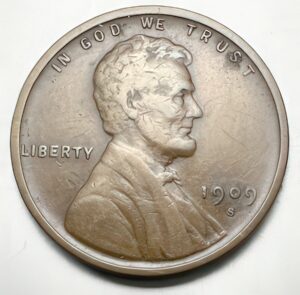
The penny Pop gave me was one I asked for. He asked me what I wanted for my birthday and I said: a penny: a 1909-S-VDB Lincoln penny.
Coin collecting was heavily marketed to children after the Davy Crocket coonskin cap craze of 1955 revealed the existence of a hot new demographic with money to spend: Boomer kids.
I was caught up in the campaign for the Whitman coin folders in which you could insert examples of the coins.
My interest wasn’t driven by the numismatic details of the stamping of the coins or the geographic distribution of the mints, but by the marketing campaign that boiled down to this:
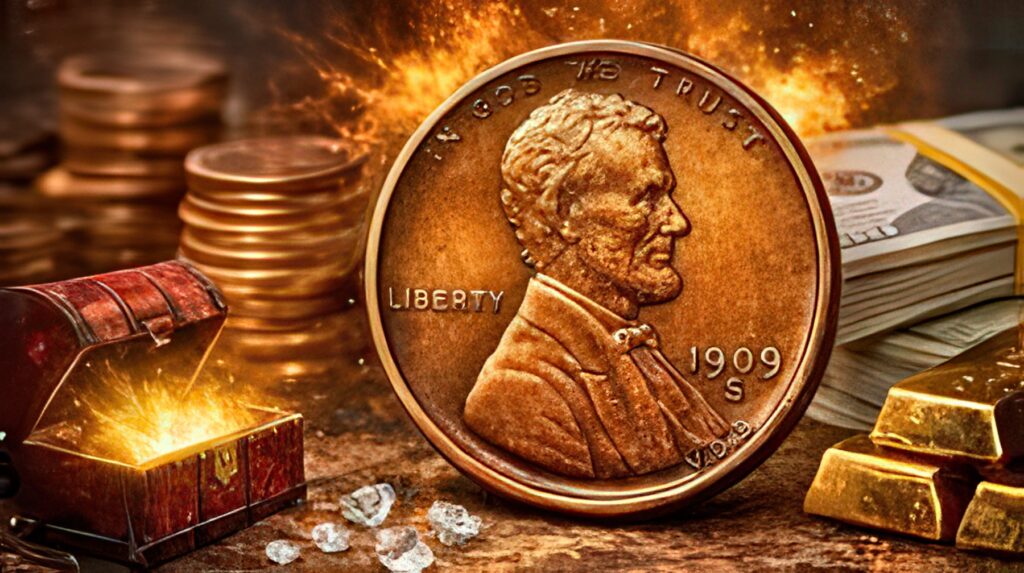
Amid all the coins being mindlessly handed back and forth between merchants and buyers there were some particular dates and mint-marks that were inordinately valuable to collectors. A 1909 S VDB penny was worth a hundred dollars back then, and I examined the date of every penny hoping to find one. Today it is valued at $2,000.
Collecting pennies in a folder that cost 35 cents was something we could afford, with the magic thrill that we could stumble across a penny worth a hundred dollars at any moment.
We were already hypnotized by penny marketing in Detroit. Milky the Clown was the host of a Saturday morning TV show. Kids who appeared on the show had a chance to reach into a big fishbowl of pennies and grab as many as they could in their fist. They could keep every penny they could clutch. I lusted to be on the show and reach into that bowl of cash.
The folder for Lincoln cents cost $0.35. I was able to scrape together that much. I started filling in the slots. Each slot listed the number of coins produced–the fewer produced, the higher the collector value. Other dates that were hotly pursued were 1914-D and 1931-S. D meant it was minted in Denver, S was minted in San Francisco. Pennies with no mint mark were minted in Philadelphia.
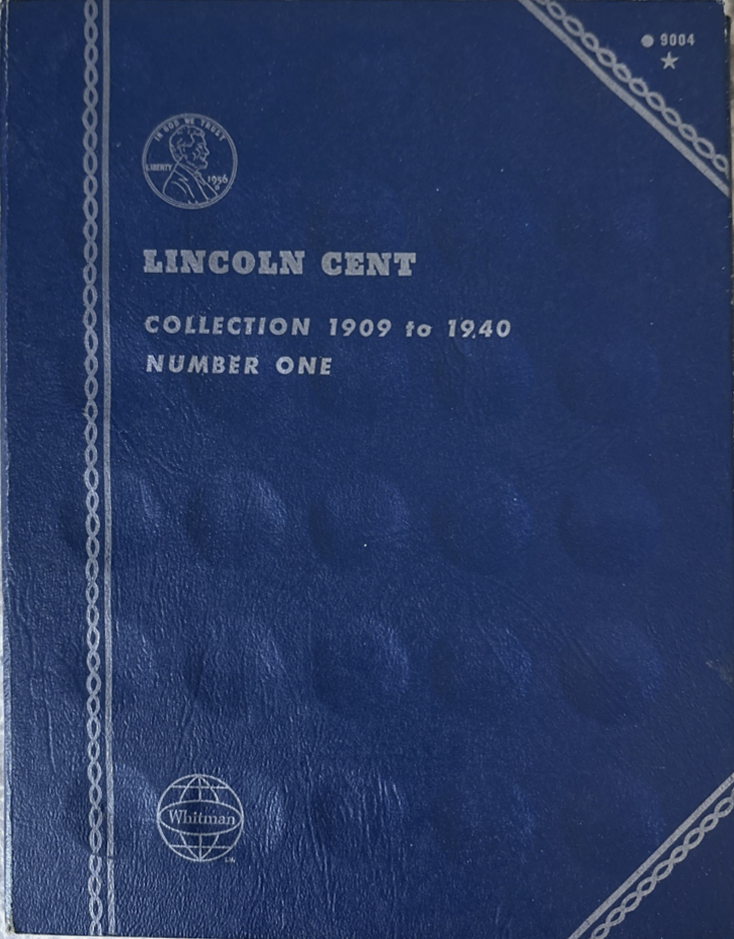
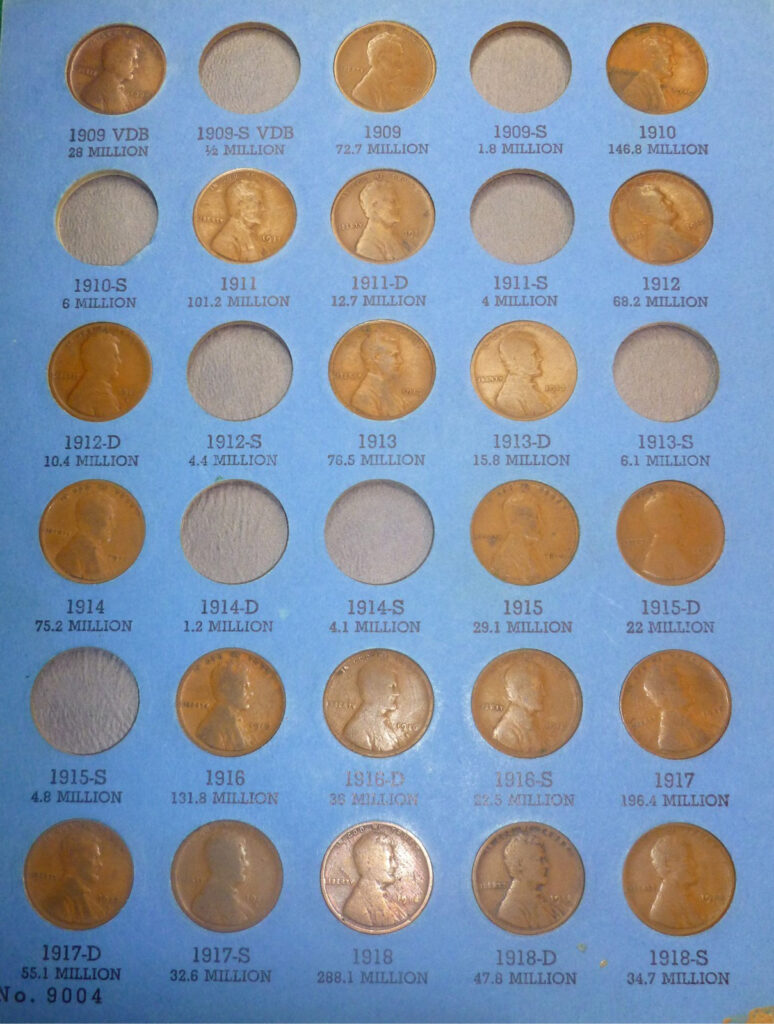
These are examples from the web. My own collection is long gone.
I got a copy of the “Red Book”–“A Handbook of United States Coins” was the actual title–with values of every US coin ever minted, listed by year and mint mark and with prices for each condition of wear–from poor to fine through Uncirculated–and got ensnared into the dream of finding highly valuable items hiding in plain view.
It was published by Whitman Publishing, known for children’s books. It is the most successful title in their publishing history; the 2026 edition is the 79th annual in the series. Over 25 million copies have been sold since its first publication, selling 200,000 copies every year. I spent a lot of time memorizing the rare dates of all coins that might still be in circulation. Whitman also published the coin folders into which Boomer kids could insert their pennies.
Coin nerds. I guess that’s what we were. I talked about it with other kids into my junior high years. Friends I could brag to if I found a semi-rare date.
I collected other coins, too, not just Lincoln cents. I routinely examined every coin I handled in hopes of finding a rare date. At a poker game one night I won a pot and pulled it in and noticed that one of the dimes was a 1916-D, the rarest and most valuable Mercury dime. I slipped it into my shirt pocket to take it out of the game and didn’t mention a thing about it to the other players. It was just a dime to them. Today it’s worth a thousand dollars.
One of my high school pals was also a coin collector and one day he came to me with a prize: an 1898-O Morgan silver dollar. The “O” mint mark meant it came from the New Orleans mint. It was fabulously rare, listed at over $1,000 in the coin books. He didn’t know what to do. Don’t take it to a local coin shop, I told him, they’ll try to screw you. I wrote a letter for him to send to a prestigious New York coin dealer.
He got a reply offering $1,500–for a bag of 1,000 coins. It turned out that the coin was rare because when the mint shut down, somebody stored all the coins in an undocumented place and after sixty years they were discovered and flooded the market.
As a teenager I had agreements with local stores that they’d occasionally let me sift through their change drawer to find rare dates and I’d swap for regular coins. One day at a corner market they gave me a 1918 quarter in change and a 1925 nickel. I asked if I could examine the change drawer and found a dozen old coins that looked very familiar. “I noticed those, too,” the clerk said, “it was your sister who brought them in. About $3.50 worth.” When I got home I checked my coin folders and saw that, sure enough, those dates were now missing. I confronted my sister Lanie and she eventually burst into tears and confessed but she wanted leniency because she only took “the oldest ones.” Not the nice shiny new ones. She had zero awareness of numismatic value.
I never trusted her about anything after that.
I lost interest in coin collecting after President LBJ’s Coinage Act of 1965 removed silver from coinage. Gasoline was 25 cents a gallon and at today’s silver price you could buy three gallons with the melt value of a silver quarter ($14.75), which far exceeds any numismatic value for most dates and mint marks.
Forty years ago or so, my brother Scott and I consolidated our coin collections. I had custody for a while, and then Scott had custody, back and forth, and then he had a tumultuous divorce from a Taiwanese girl and when the dust settled the coin collection was nowhere to be found.
Scott hired a private detective who tracked down eleven bank accounts and safe deposit boxes that the now-ex-wife had concealed from the court during community property division hearings, but the coin collection never turned up. I conjecture that it would be worth around $10,000 today.